
Understanding and Reporting Hate Crimes

HATE CRIMES
A crime becomes a hate crime when it is motivated by bias against a specific community.
This includes crimes that target people for their:
- Race or Ethnicity
- Religion
- Sexual Orientation
- Gender Identity & Expression
- Mental or Physical Disability
- Age or Sex
HATE INCIDENT
Not every hateful act is a criminal offence, but every incident matters. A hate incident includes any behaviour motivated by bias, such as:
- Slurs or offensive language
- Insults regarding ethnic or religious clothing
- Hate-motivated bullying or social exclusion
How do I know if a hate crime has been committed?
Sometimes it is clear when a crime is motivated by hate. Other times it may be less obvious. Key indicators that a hate crime may have been committed include:
- Comments made during the incident
- Motivation of the perpetrator or even lack of an apparent motive
- Victim’s perception that they were targeted
- Display of hate symbols, gestures and language
- The manner in which the offence was committed
- Recurring patterns of harassment, humiliation, or intimidation
- Other relevant circumstances surrounding the offence
HATE CRIME or HATE INCIDENT?
Is it a crime?
Maybe. A crime like vandalism or assault becomes a hate crime if it is motivated by bias. If it is not a crime, it is a hate incident.
Does it matter?
Yes. Hate-motivated crimes often lead to tougher sentences in court.
Should I report it?
Always. Reporting hateful behaviour - even if you aren’t sure it’s a crime - helps the police monitor hate activity and protect our community.
Canadian Charter of Rights and Freedoms - Your Fundamental Freedoms
Under Section 2 of the Canadian Charter of Rights and Freedoms, everyone in Canada has the right to:
Religion - Freedom of conscience and religion
Expression - Freedom of thought, belief, opinion, and the press
Assembly - freedom to gather peacefully
Association - Freedom to connect with others and join groups
HATE SPEECH IS NOT PROTECTED BY THE CHARTER.
HATE CRIMES IN CANADA
The Criminal Code of Canada (Sections 318 and 319) address the following criminal acts:
- Advocating Genocide
- Publicly Inciting Hatred
- Willfully Promoting Hatred
- Willfully Promoting Antisemitism
CONTEXT IS EXTREMELY IMPORTANT IN HATE PROPAGANDA INVESTIGATIONS.
How to Report Hate Crimes
IN AN EMERGENCY CALL 9-1-1
Reporting incidents helps police to identify patterns, investigate crimes, support victims, and prevent future incidents. Even if you are unsure if an incident is a hate crime, we encourage you to report it. To report a hate crime or hate incident to the Brantford Police Service that is not an emergency:
Call the NON-EMERGENCY number to speak with an officer 519-756-7050
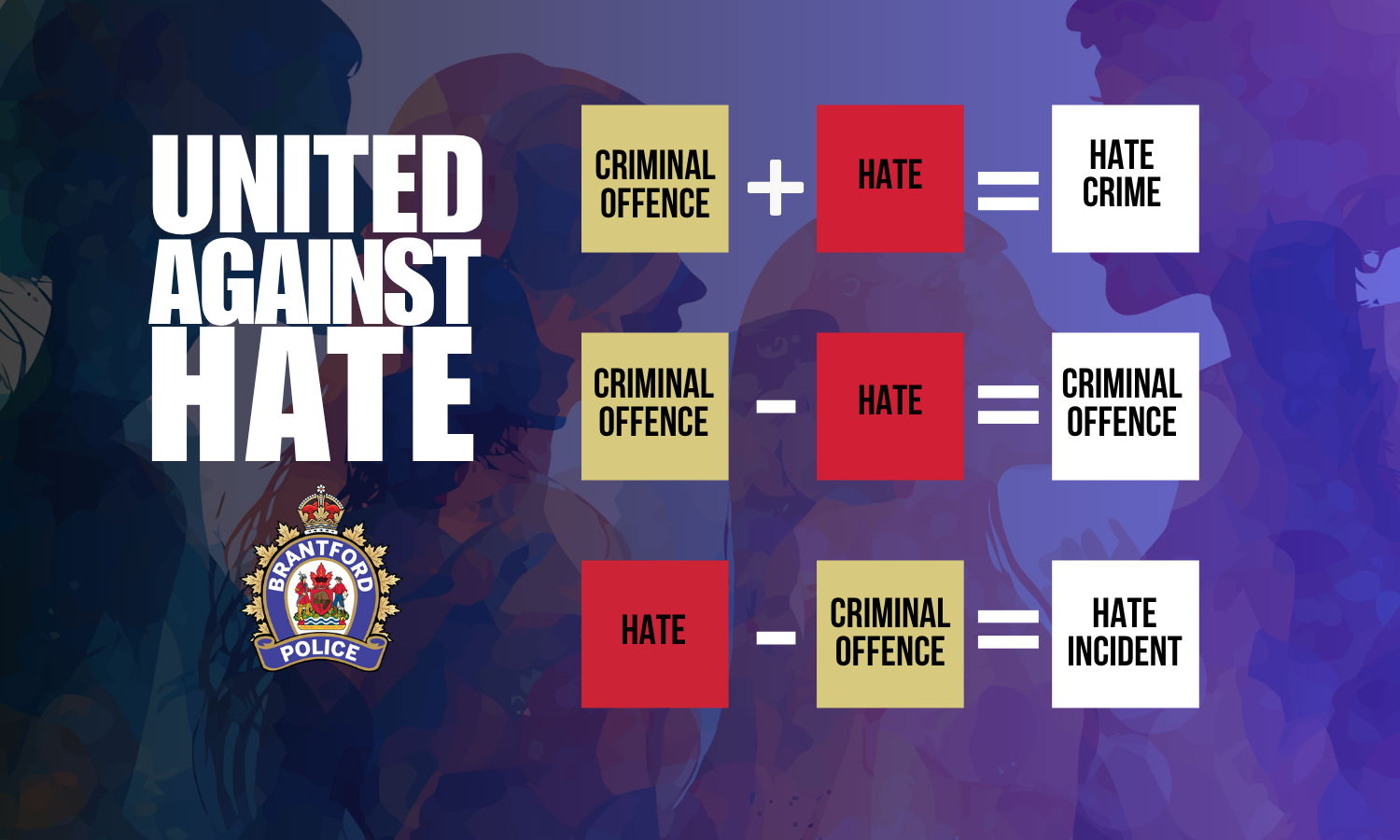
United Against Hate Information Brochure – Available in Multiple Languages
Everyone deserves to feel safe, respected and supported in our community.
To help ensure information is accessible to all members of our community, the United Against Hate information brochure is available in multiple languages. This brochure explains:
- What constitutes a hate crime and a hate incident
- How to report hate-motivated incidents
- How the Brantford Police Service investigates reports of hate crimes and hate incidents
If English is not your preferred language, you can download the brochure in the language that best meets your needs using the links below.
Available languages:
- Arabic
- Chinese (Simplified)
- English
- French
- Hindi
- Italian
- Korean
- Polish
- Portuguese
- Punjabi
- Spanish
- Tagalog (Filipino)
- Ukrainian
- Urdu
- Vietnamese
Together, we can help build a community where hate has no place. If you have experienced or witnessed a hate crime or hate incident, we encourage you to report it.